The Hilarity in Absurdity.
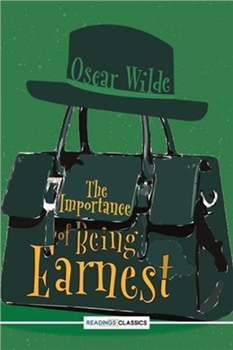
‘The Importance of Being Earnest,’ by Oscar Wilde was indescribably entertaining and an utterly hilarious read, which I hadn’t expected in the least from an 80-page play.
The wit of Wilde’s writing and the ending that couldn’t have been more fitting, ensured that I kept turning the pages until I had reached the very last word.
The story observes Algernon and John, who describe to each other whom they use to get out of awkward social obligations (in Algernon’s case) and for John (who goes by Jack to his friends), to simply be carefree and have less general responsibility with a person he calls “Earnest”.
Jack uses “Earnest” to display his love to Gwendolen, Algernon’s cousin, who announces her pity for any woman who could marry someone called “Jack,” and that unlike the prior name, “Ernest” doesn’t lack “vibrations.” From this point on, the duty to uphold this persona is no longer retractable.
Similarly, Algernon loves Cecily, Jack’s ward. Both men decide to ask the women to marry them, the pair equally going by the name of Ernest, and both ladies accept. Yet at the refusal of Gwendolen’s mother towards her daughter and Jack’s marriage, he decides the only thing to do is to cross Algernon.
At this moment, everything begins to appear entirely ironic, light and still quick-paced as ever. Especially once Lady Bracknell demands “A Handbag?!” in responding to Jack’s birth story.
When considering the supposed sorrow in the tale he told, I must emphasise the humour in the line which one can only imagine comes with a priceless look on her face. I envisage one of pure shock, which a reader cannot fully understand when only reading the play.
I must mention Wilde’s conceptualised ideas of marriage, as throughout the play he consistently mentioned his views through the character of Algernon. He reacts to Jack’s proposition of wanting “to propose” to Gwendolen with the statement that marriage is “business.” He also deems it necessary to publicise how “excitement is all over” once you’re married.
I would also like to comment on the views on social class and how obnoxious those who are more fortunate can seem out of context. To demonstrate Wilde’s criticism on this topic, the conversation concerning “fools” between Algernon and Jack must be included in this review.
Jack: “I wish to goodness we had a few fools left.”
Algernon: “We have.”
Jack: “I should extremely like to meet them. What do they talk about?”
Algernon: “The fools? Oh! About the clever people of course.”
Jack: “What fools.”
Finally, at the moment where this satirical piece of writing becomes of a certain significance, is when everything we believe to be absolute nonsense, is finally identified to be the truth.
“Gwendolen, it is a terrible thing for a man to find out suddenly that all his life he has been speaking nothing but the truth. Can you forgive me?”
For Algernon is the brother Jack has ‘lied’ about and Jack was christened “Ernest” at birth! Everything we once knew to be decieving, was satisfyingly correct.
Ultimately, I must credit Oscar Wilde for this fantastic play that left me in awe at the hilarity in his writing. The final touch was, of course, the double meaning in the title.
Yet the only downside to the work was that it wasn’t longer, as I would have loved to be laughing in my seat for another few pages. This play shocked me immensely, and it is one I couldn’t recommend enough, if that wasn’t clear from my previous notes of gratitude.
Through this piece, Wilde conveyed some of his greatest writing, and for a comedic play and, for what it is, I could describe it as phenomenal.
 Life With Literature
Leave a comment