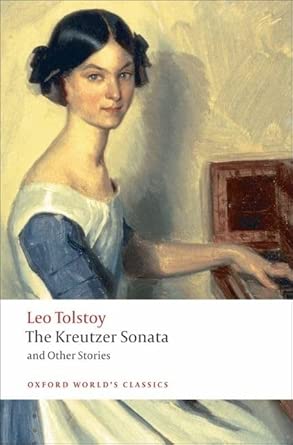
The Kreutzer Sonata by Leo Tolstoy explores an unconventional point of view where marriage is portrayed like attritional warfare, and society simply acts as a body of people who corrupt our view on this unification before the papers are signed. The novella defends the idea that women should be appreciated, using many female characters to debate the notion argued in his book, yet the ultimate argument surrounds the toxicity within, pledging eternal devotion to someone else.
Tolstoy presents a depiction of marriage as something that is doomed to end, through the construct, Pozdynshev, who speaks of how it decays through mutual hatred, leading to the eventual stabbing of his wife after finding her with a violinist. Tolstoy uses his protagonist to describe how “tedious” a “honeymoon is” as though the celebration of love is tiresome and unbearable.
The Kreutzer Sonata was written before ‘A Christmas Carol’, where Charles Dickens used Marley’s Ghost with chains and money boxes to demonstrate his greed and eternal afterlife atoning for himself in purgatory.
Yet Tolstoy, in having a similar analogy to describe marriage, shows how this bond is a punishment. Pozdynshev describes how he and his wife were “like two prisoners in stocks” who hated each other and were “fettered to each other by the same chain,” which conveys how marriage erodes in both parties, and where they are “poisoning each other’s lives.” This links to Dicken’s ghosts in stave one as they “were linked together; none were free.”
Similarly, Tolstoy doesn’t hesitate in comparing marriage to an extreme, linking it to the supernatural forced to live in regret, but also like “a kind of truce” that they “couldn’t find any reason” to break. In comparing it to a stalemate on a war front, Tolstoy is highlighting the equal fight on both sides yet the inability to end things, showing how divorce was not so much as a legible option.
One of Tolstoy’s key messages throughout the novella was that society plays a key part in tainting our view of marriage through a vicious cycle of repetition, as though to sabotage us because they couldn’t achieve love.
Pozdynshev, as a mouthpiece for Tolstoy’s views, argues that if his wife had known the reality of marriage, it would have prevented the entirety of it in the first place. He describes how his wife “got married,” managed to get a “bit of that love she’d been told about,” but that it was “far from being what she’d been promised.”
Overall, this conveys how underwhelming Tolstoy believes that the experience is. By being given a baseline by society of how marriage is, it creates immense letdown when it isn’t so glamorous.
Yet the downward spiral continues, because it would be foolish to blame those that don’t experience firsthand how our marriage is, so we blame our partner. Pozdynshev begins to question “how can this be… love is supposed to be the union of souls, and not this…this isn’t the woman I married.” His exclamation of this apparent betrayal led him to interrogate his wife, despite their marriage being by his choice.
During 1889, when The Kreutzer Sonata was written, the Russian Orthodox church acted as a point of inspiration for Tolstoy. As he describes how society impacts our perception of marriage, he says that we “fell because of the society (we) lived in,” linking his anger to the fall with Adam and Eve.
Through this biblical reference, Tolstoy is arguing that like the snake in Genesis (chapter three), society acts as a form of destruction, impacting life for generations.
Just as the fall prompted the beginnings of evil, sin and shame, marriage creates a chain reaction leading to children falling for their elder’s traps and marrying someone else, for generations.
To conclude, The Kreutzer Sonata argues for life without eternal unification, being linked with the musical piece by Beethoven which explored the lengths that a violin sonata could achieve.
It demonstrates that marriage is a raw force that mostly causes pain and “mutual hatred.” Through both religious reference and societal impacts on this theme, Tolstoy expresses how true love is mostly carnal and formed by a desire to have children, ultimately arguing that marriage is never what it seems, and destined for misery.
 Life With Literature
Leave a comment