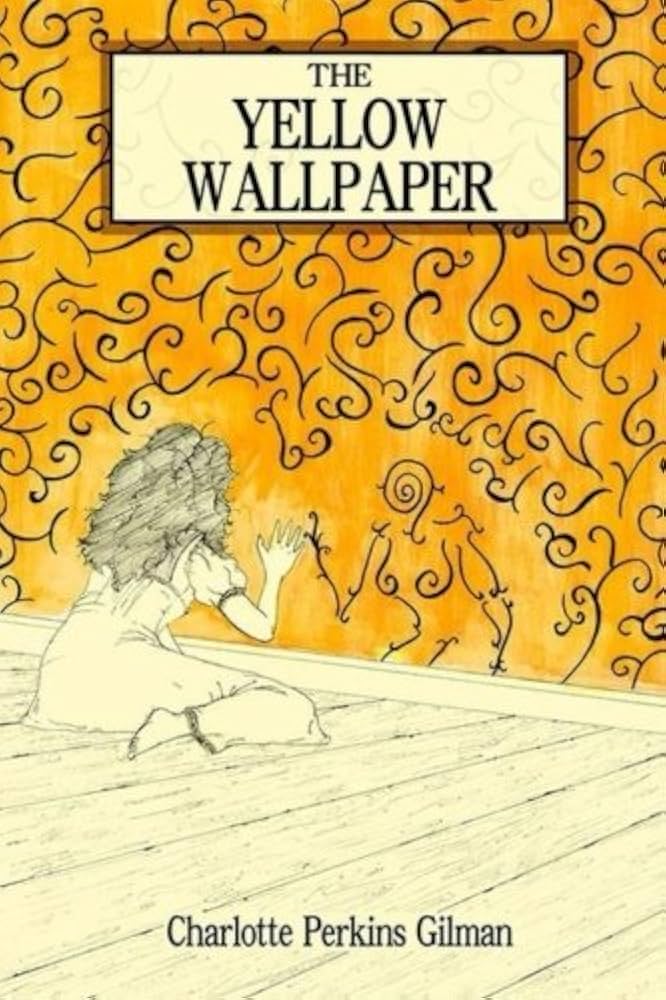
The Yellow Wallpaper, written by Charlotte Perkins Gilman, critiques the rest cure through a gothic semi-autobiographical short story, grappling with autonomy and symbolism with an unnamed narrator. It discusses themes of liberty through irony but also consciously juxtaposes light versus darkness, ultimately using the yellow wallpaper as a plea for society to recognise aspects of depression and the limitations of the rest cure.
Our narrator and her husband, John have rented a home for the summer, for her to get better – presumably she is considered to be mentally unwell. The short story depicts the madness of the narrator while her husband dismisses it as improvements, whereas in reality, she is becoming infatuated with the yellow wallpaper. It is described as “hideous enough/ and infuriating enough, but the pattern is torturing,” with emphasis on the “smouldering, unclean yellow” that is a “dull yet lurid orange in some places, a sickly sulphur tint in others.”
Throughout a series of journal entries, the narrator is driven to psychosis as she eventually rips off the wallpaper, believing it has a trapped woman within who comes out at certain times, until she finally believes that she was the woman within, and is now free.
Gilman criticises the rest cure which seemed predominantly targeted at women who may have had postpartum depression. Doctors felt that simply resting people and isolating them from society would lead to wellness, despite the absurdity that we now know that that would cause.
The narrator represents those that disagreed with this decision, arguing that if she “had less opposition and more society and stimulus,” then it would’ve caused improvements to her health. She even broadly states that “excitement and change/ would do” her good. Yet her surroundings remained unchanged, eventually causing a need to hyper fixate on wallpaper for a lack of anything better.
The Yellow Wallpaper uses light and dark to explore how the portrayal of freedom changes. “By daylight there is a lack of sequence, a defiance of law.” This represents the dismissal of normalities, evidently being why the narrator obsesses over the curtains which are constantly changing, as she chases a change is power dynamics and the imbedded opinions of society. In the dark, that wallpaper “becomes bars” which the woman in the paper “takes hold of/ and shakes/ hard,” almost as though women are trapped. They are invisible yet seen by others in the same position.
The husband of the narrator is presented as one of many who compare his wife to others. By constantly referencing her inferiority by placing her against stereotypical roles of a woman and therefore describing her as a child, it reinforces Gilman’s message that autonomy should be a choice for all. She curates John’s language, so he is always belittling his wife, calling her a “little girl” with a “slight hysterical tendency.” He is playing down her situation and forcing her to believe that she should be doing her “duty” as a “sensitive” woman.
He invites his sister, Jenny, over to extend the narrator’s own feelings of guilt, while explaining that it would make her feel better to watch a “perfect and enthusiastic housewife (who) hopes for no better profession.” This insinuates that the narrator isn’t acting as she should be as a wife because of her inability to serve him as of that moment.
At the novella’s close, the narrator is “out at last,” with a “bare” wall as so much of the paper had gone that you wouldn’t be able to “put (her) back.” This acts as an ironic liberation as she becomes the woman who was trapped yet is now free but at the cost of her sanity. Her ultimate proof of freedom is her ability to “creep over” her husband who had fainted onto the floor, as she is now above him physically and metaphorically – she has reversed the dynamic between man and woman in that instant.
To conclude, The Yellow Wallpaper, in just six thousand words, has portrayed the necessity to reconsider treating some illnesses (postpartum depression in particular) with the rest cure. Yet also, that we require autonomy, or else we will rebel until it is awarded to us.
 Life With Literature
Leave a comment