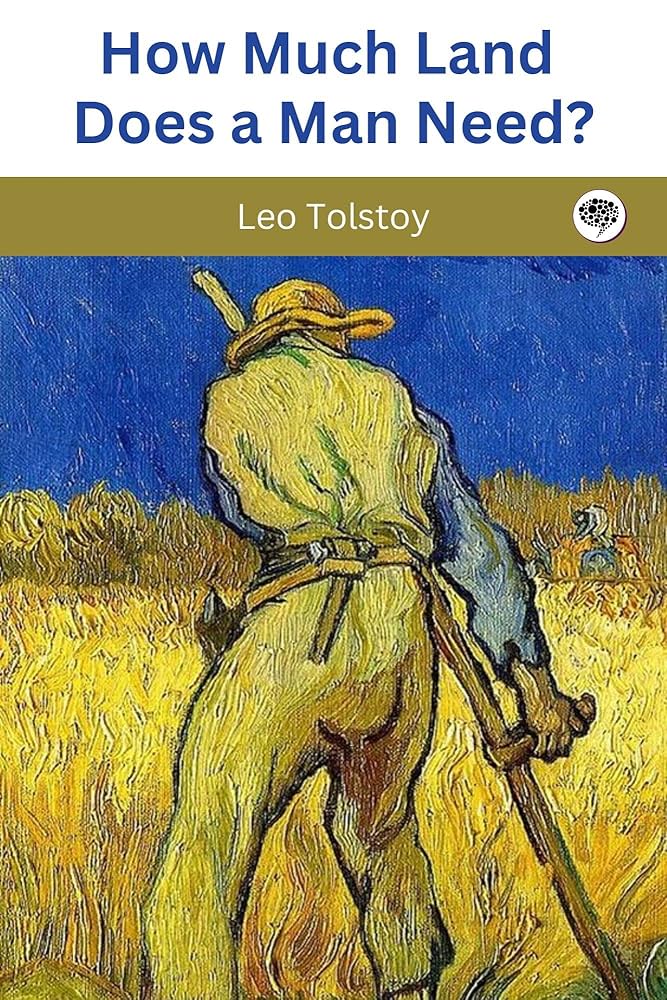
In ‘How Much Land Does a Man Need?’, Tolstoy uses the construct of Pakhom to describe the futility of greed, as it is an unfulfilling desire which eventually leads to death: in this story, as a metaphor for unhappiness and the loss of true wealth.
‘How Much Land Does a Man Need?’ begins with two sisters with opposing financial situations, who discuss the benefits of their own lives, specifically their control over other people.
As unnamed characters, these women serve to subtly introduce the devil as an effect of ignorance, with the younger sister stating that “all may be well one day,” but the next day, “the devil comes along and tempts your husband,” who is the central figure in the novella.
Their contrasting views depict riches as a battle worth fighting for, where you live in “grander style,” yet the opposing argument is that the effort is too much for a comparably thankless result.
The humbler sister foreshadows the devil’s power over a man tempted by what could be, by claiming that her class doesn’t “have to crawl to anyone,” and they’re “afraid of no one,” whereas the upper class worries most about losing their money through a narrow-minded lens which fails to see the damage around them.
Following the two sisters’ discussion of life at each end of the spectrum, Pakhom is introduced as someone who owns some land, but is still influenced by the richer landowners. He complains of how farmers should be kinder to him, as he can’t help that his livestock are walking out of his own fields.
In discovering a bigger stretch of land for a cheaper price, he immediately takes it. From here on, a vicious cycle begins, with Pakhom becoming rich in land, and disregarding the peasants whom he once wished the farmers would pity. He constantly asks why he should “have to scrape a living cooped up here?” despite having hundreds of acres of land.
His harmless desire for more soon extends to being arrogant and egotistical, with his greediness directly proportional to the amount of land he owns. As his land increases, so does his insatiable hunger for more of it.
As readers, we can’t help but notice how the narrator doesn’t support Pakhom in his choices. Perhaps this narrator is God: as Pakhom is Christian and slowly turning to the devil, God is trying to prevent a minor version of the fall as Pakhom disregards God’s will. The narrator states that “although Pakhom had plenty of land now, he felt that the commune was hemming him in,” arguably emphasising how it’s only Pakhom himself who feels hard done by.
Tolstoy seems to be insinuating through Pakhom that greed is an unchristian trait, and that it can lead to the forgetting of the true meaning of faith. This is because it is obvious how Pakhom is overestimating his ability for self-control, explicitly saying that if someone were to “Give [him] enough of that [land],” he would “fear no one – not even the devil himself.”
Yet in the Bible, it says not to “live in fear of the devil” but, similarly, not to be “ignorant to his schemes,” which Pakhom is doing simply by ignoring God, meaning that for a dutiful Christian, he may be at the other extreme – the devil.
The final challenge that will apparently satisfy the desire for more land is one posed by the Bashkirs, a group who have so much land that they’re willing to let someone pay a small cost for as much land as they can walk around and dig in one day. However, if you don’t make it back in time, then you lose all the land you had captured, and the money. Of course, the Bashkirs make their money by relying on the greed of the people they challenge.
Pakhom is one of these people. Yet before the day of the walk, he begins to dream that the devil is laughing at him. “Before [the devil] lay a barefoot man wearing only shirt and trousers. When Pakhom took a closer look, he saw that the man was dead and that it was himself.”
This narrative is from the point of view of Pakhom, and interestingly, he notices not that the man is himself first, but rather the situation. We hope that Pakhom will redeem himself at some point in the novella, yet this realisation that he can’t understand his personal consequences first reveals to us that he is destined for his fate.
Pakhom says: “A moment’s pain can be a lifetime’s gain.” The poor sister says: “You know the proverb, ‘Loss is gain’s older brother.’”
Finally, Pakhom begins to walk. He begins to play into the psychological effect of the sunk cost fallacy, meaning that once he goes so far that he realises he won’t be able to get back in time, he places his pride above his health, and strives to finish what was pointless to have started, based on his habit of greed. He internally notes that “although he fears death, he could not stop,” and how if he “stopped now after coming all this way – well they’d call [him] an idiot.”
Eventually, he reaches the end; he has persisted and now owns many acres of land, but “Pakhom was dead.” Perhaps it was just greediness, or the punishment of God, which caused him to die, but Tolstoy makes sure to use irony in that Pakhom’s worker digs his grave “six feet from head to heel, which was exactly the right length,” as though Pakhom only needed six feet for his grave, not the hundreds of acres he had gained in life.
To conclude, in ‘How Much Land Does a Man Need?’, Tolstoy argues that greed doesn’t equal happiness, but rather the opposite, with it being not just a hunger for more, but the fear of having anything less. In ending the novella with the fate of all humans, he shows that all of us are headed the same way, and therefore there is no need for greed, as what you had doesn’t matter in the grave. The poor sister at the beginning summarises Pakhom’s journey well before it had begun: “You know the proverb, ‘Loss is gain’s older brother.’”
 Life With Literature
Leave a comment