
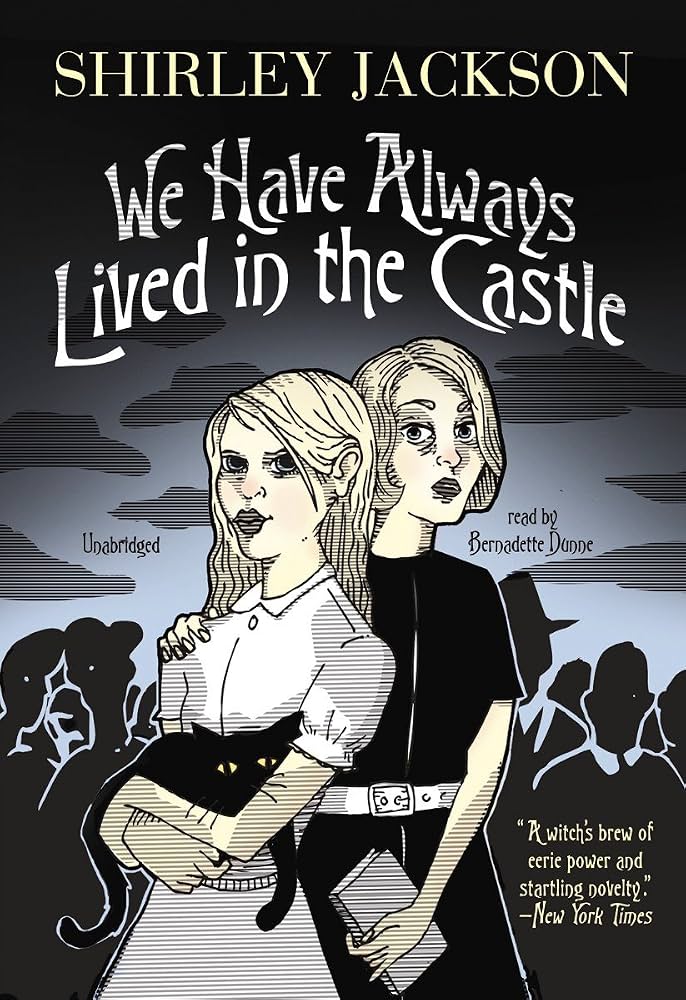
The novel We Have Always Lived in the Castle by Shirley Jackson explores otherness within a community, as well as the sympathy and lack of judgement that a family can provide. Jackson also presents change as both unavoidable and dangerous for a family that seeks protection from the outside world.
The sisters, Merricat and Constance Blackwood, live with their Uncle Julian as an isolated family within a neighbourhood that views them with disgust because the villagers believe Constance murdered her family. She had been arrested and charged with the murder of her entire family after arsenic was put into the sugar while Merricat was upstairs. Although the rest of the family was poisoned, Constance was acquitted, but the rest of society believed she had got away with murder.
Yet, as the story progresses, Merricat – the only person who goes out to collect food and books from the library, and who is verbally abused by the villagers – is revealed to have put the arsenic in the sugar herself, knowing that her sister would survive because she never took sugar. This revelation forces the reader to question their assumptions about the Blackwoods, as the person whom society victimised is not the person responsible.
Once their cousin Charles arrives and forms a bond with Constance, Merricat immediately senses his desire for the Blackwood fortune and becomes openly hostile towards him. One night, after Merricat angrily throws Charles’ pipe into the bin, it starts a fire.
The villagers initially help to put it out but eventually begin ransacking the house, while Uncle Julian apparently dies of heart failure. The sisters retreat into the forest, and Charles attempts to steal the safe. Afterwards, Constance admits that she knows Merricat was the one who poisoned the sugar.
When the sisters return to their damaged home, they see that it resembles a castle because it no longer has a roof. From then on, they watch the villagers through a peephole and remain isolated. Feeling remorse for their actions, the villagers begin leaving food at the door.
Charles later attempts to return with a journalist, hoping to persuade Constance to leave with him, but she ignores him. The sisters ultimately choose to remain alone, relying only on each other and the food left at their door, becoming a small family that willingly separates itself from the rest of the world.
The story primarily explores change and how it is something many people try to prevent because they wish to preserve their current situation and sense of security. In the novel’s introduction to the Blackwoods, Jackson highlights how the family was “never much of a family for restlessness or stirring.” This suggests that the Blackwoods value routine and permanence, creating a fragile sense of safety that depends on preventing outside influences.
From the perspective of a family who hate the idea of their lives becoming unpredictable, change is presented as negative and as a disruption of normality, with Charles’ arrival triggering a chain of events that destroys the stability of the Blackwood household and ultimately leads to the fire.
Similarly, Jackson explores compassion through Constance’s care for Uncle Julian. She laughs “when she worked in the garden, and it would always be the same,” while Jackson also presents isolation as the underlying tone of the novel.
Merricat’s chilling narration, telling us that “everyone… in my family is dead,” alludes to her emotional detachment. This contrasts with the empathy she shows Constance, largely because of the lack of judgement her sister shows towards her, even after it becomes clear that Constance knows the truth about the poisoning.
Jackson uses the sisters to convey the ability to nurture and love one another despite their opposing mindsets and roles, with Merricat harbouring hatred towards the villagers while Constance embraces a domestic role through cooking and cleaning.
Merricat uses magic to protect herself, revealing her desperation to maintain control over a world where she feels powerless. She decides that she would choose “three powerful words, words of strong protection, and so long as these great words were never spoken aloud no change would come.”
Finally, Jackson presents otherness as one of the central themes of the novel. She portrays the Blackwoods as completely out of touch with the hostile community around them, yet does not present otherness as something that is always lonely. Instead, she challenges this idea by showing that their isolation strengthens the sisters’ bond and creates a sense of security that they cannot find in the outside world.
Although society rejects them, they ultimately choose to embrace their otherness rather than conform, suggesting that acceptance within a family can be more meaningful than acceptance from society.
To conclude, We Have Always Lived in the Castle is a novel that shows how isolation can be both protective and destructive, while family can provide shelter from the judgement and abuse directed towards those who are different. Jackson ultimately encourages readers to question their own perceptions of people like the Blackwoods, suggesting that we should respond with understanding rather than prejudice, as we rarely know the full story behind someone’s actions or circumstances.


Leave a comment