How Conflict Mentally Disrupts Individuals
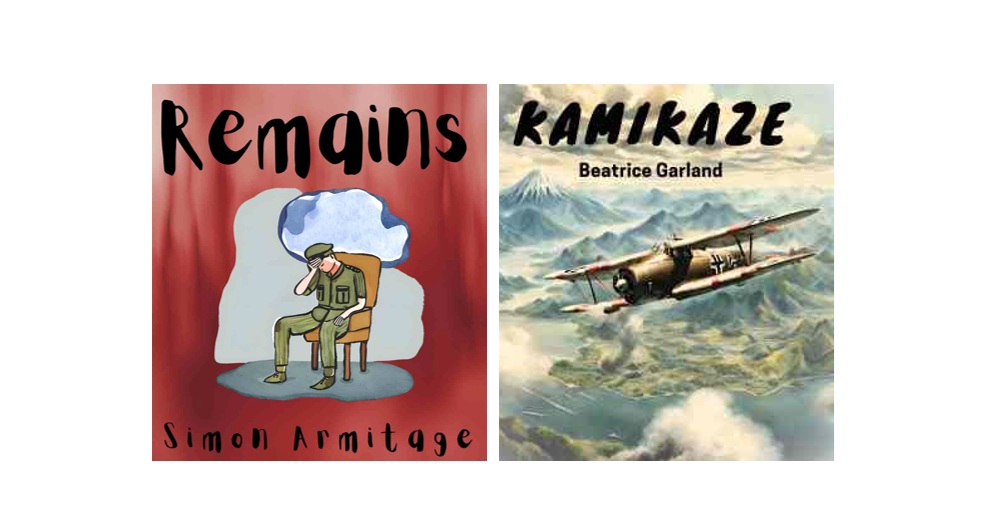
Remains by Simon Armitage and Kamikaze by Beatrice Garland both present the effects of conflict as something that forces maturity, creates a constant memory, and forms a ripple that extends not just to a single person but also to family, while also demonstrating that conflict can make people feel intense guilt over their actions.
In the first few stanzas of Remains, the narrator uses colloquial language. The future victim “legs it” up the road, and once dead, his friend “tosses his guts” into a lorry.
This use of childlike speech insinuates that the narrator is slightly immature and does not yet understand the acts that his group have committed. Yet in the fourth stanza, Armitage constructs a volta where an “end of story” does not actually take place. Immediately, the offhand comments disappear, and the reader understands that the murder stays with the narrator and is no longer a joke.
This demonstrates that conflict forces maturity, as we can see the awareness of the narrator after the man he killed is carted away, alluding to the fact that the loss of a human life has made him change entirely.
In Kamikaze, the writer presents the effect of conflict on the individual in a different way from Armitage. In contrast to conflict being glorified and only then leading to pain and mental burden, the individual suffers before the conflict.
In Japan, the kamikaze suicide bombers would be chosen and fly out with only enough fuel for a single journey to crash into enemy ships or supplies while sacrificing themselves. Yet the individual in Kamikaze feels the fear of his job before entering the conflict, turning back after noticing the nature surrounding him.
Both poems are similar in that conflict leads to immense guilt afterwards. Remains shows that the man he killed is a lingering memory whose “life” was ripped through, almost as if, to him, it was not just a body but a soul that was taken away.
This is especially significant as Armitage contrasts his poem’s themes of shame with previous war poems where the actions brought nothing but glory. Then, in Kamikaze, the man returns to find his family and the neighbourhood silent and treating him with hostility.
They refuse to look at or speak to him solely because his abandonment brings dishonour to the family. Therefore, both poems describe the effect of conflict as lasting and hard to endure, with lifelong effects on an individual.
While both poems explore conflict leading to memories, with Kamikaze referencing the man’s grandfather and his boat, the poem Remains describes memories in a more horrific way. He had to personally live through mass death, with Armitage choosing to use repetition for the victim being “probably armed, possibly not”. This signifies the reliance of the individual on the man he killed having a gun, implying the narrator’s desperation for his action to be blamed on self-defence.
We can see that the individual feels such anger at what he did, showing a willingness to see the futility of war. The man is “in (his) head” when “(he closes his) eyes”, and Armitage’s use of enjambment highlights that the memory is everlasting and does not follow order or system, depicting the effects of conflict as dehumanising.
It strips away what makes an individual human until he is nothing but the memory of the man he killed. The final line relates to literature of the Jacobean era, with Shakespeare’s Macbeth, which features Lady Macbeth and her attempt to wash the blood off her hands. The narrator states that the victim’s “bloody life” is in “(his) bloody hands”, showing how he relates to the guilt of Lady Macbeth and how conflict has terrifying effects on an individual.
To conclude, both poems present the effects of conflict as traumatic and irreversible. Yet in Kamikaze, these effects extend beyond the personal world, while the individual in Remains suffers in silence. Armitage displays that the narrator has a memory that can never be removed and is painful, while the only traces of memory in Kamikaze are of his grandfather’s boat.


Leave a comment