
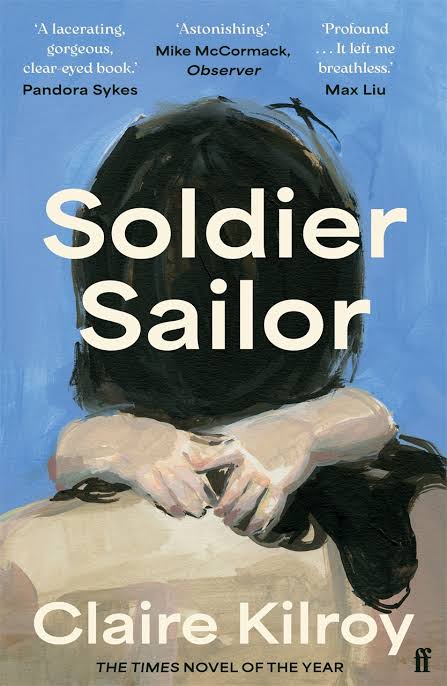
Claire Kilroy’s novel, Soldier Sailor, suggests that identity is defined by the experience of motherhood. Her journey makes some people feel as though she is an unreliable narrator, while others may simply see a woman crumbling beneath the pressures of effectively being a single mother. Ultimately, Kilroy questions the toll of motherhood and explores the extent to which an unspectacular mother will go for her child.
Kilroy initially presents the mother as someone who blames others for many mishaps in her life. Some may argue that she is an unreliable narrator because of her intent on minimising the actions or good deeds of those around her, particularly her husband and son, while ignoring their own roles or inability to comprehend her pain.
In some ways, it seems that she pushes the blame onto them, as they are blissfully ignorant of the mental toll that they bring, almost as though ‘motherhood’ as a lifestyle is a scapegoat to avoid criticising her own problems.
She explains to us, both the reader and the son whom she wants to understand the grief of motherhood, that “you wouldn’t eat and I couldn’t sleep. Mother and child,” as though she can blame her son for her loss of sleep and then put all of it under the umbrella of parenting. Perhaps even the names she has given herself and her son are intended to make her feel superior and her son inferior, representing a tendency to make others the victim unknowingly.
However, others may disagree with this statement, arguing that an identity is not solely defined by motherhood, but instead by other things such as having time for self-care, creativity and autonomy. Her husband is presented as someone who removed her personal choice, depicting him as someone who “started on [her]” and left her on the “bottom rung”, where she “set foot in an underworld where everything was inverted.” This highlights her tendency to fault others, as though she never had any agency.
Soldier is a desperate mother who loses her sense of self by never prioritising her own health. Through her blunt portrayal of motherhood and first-person narrative, the reader feels that they are in the mind of someone extremely self-aware, both living her life for herself and her child, and watching herself live it.
Kilroy’s structural choices in the novel may support the idea that identity is shaped by the experience of motherhood, as it is set out like a stream of consciousness, with constant thoughts that are mixed up, demonstrating a potential lack of autonomy due to her life as a mother, where she is constantly forced to care for a child whose father does not play an active role in their life.
“We all go bustling about, pushing shopping trolleys or whatever, acting like love of this voltage is normal; domestic, even. That we know how to handle it. But I don’t.”
Soldier gives us an insight into the reality of motherhood and how it interferes with everything in life to restrict personal movement that does not benefit others.
To a huge extent, identity is shaped by the experience of motherhood. Soldier shows this through her battle with postpartum depression, which she names “life-is-shit depression.”
Despite her intense desire to look after her son and her intent on making it known to him that “There is nothing a mother would not do to protect her child from harm,” her disregard for medical help offered by her husband alludes to how she is not entirely mentally sound, as she does not choose to accept the necessity of medical help.
Her identity is therefore defined by motherhood, as she has forgotten that good health will benefit the most significant person in her life: Sailor, her child, who is an “idealised image” in her mind.
Furthermore, her old friend, who joins her in the later part of the novel, is a stay-at-home dad who takes care of three children and embodies the more helpful foil to Soldier’s husband. Kilroy leaves it up to interpretation whether he is real or fictional, with the emphasis being on why he has come into her life.
Was it because of her mental fatigue? A sign that she has reached a point of exhaustion and was forced to potentially create a sympathetic, reassuring person? Or was she just in severe need of a friend?
Ultimately, the novel ends not with a solution to motherhood, nor to her isolation, because Kilroy wanted to convey that with each end to a chapter in motherhood, another begins.
Soldier begins to realise the vulnerability that her fragility has imposed on her son, and her own crippling fear of mortality, concluding with an understanding that the stress of parenthood will never ease. Sailor was a part of her from the start of her own life, a risk she took from conception to “Give life to their babies”, and Sailor always will be part of her.
This ending may seem bitter and incomplete, perhaps. Yet it captures the imperfections of motherhood and does not hesitate to mention the unsavoury parts of the “excruciating pain” where women’s “inner parts” are “torn,” because her depiction of motherhood is not filtered.
To conclude, Kilroy suggests that identity is entirely shaped by motherhood. Her raw description of life as a mother captures the toll of caring for another being on every other factor in life, be it friends, the rest of the family, or autonomy.
Despite these components of life shaping identity, there can be no debate that motherhood definitively gives mothers a different sense of self. Kilroy highlights, through Soldier, the bittersweet nature of children, which opens readers’ eyes to how a child mentally changes the mind of a mother.


Leave a comment