Poems: The Man He Killed (Thomas Hardy) and War Photographer (Carol Ann Duffy)
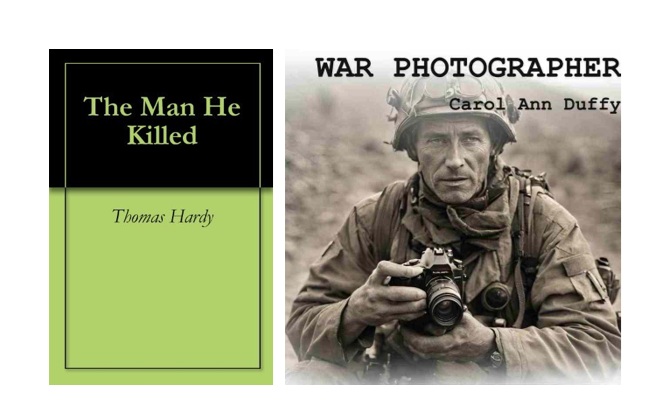
The Man He Killed by Thomas Hardy and War Photographer by Carol Ann Duffy explore the dehumanising nature of war and its impact on human empathy.
Duffy speaks from the perspective of a photographer reliving the lives of people affected by war through photography, while Hardy speaks as a soldier reconsidering his decision to kill another man. Both poets use poetic devices such as sibilance, metaphor and juxtaposition to convey their characters’ attempts to justify the arguably immoral acts they have committed.
Firstly, Duffy uses a cyclical structure to emphasise the futility of the photographer’s actions while representing the continuous nature of trauma. She also employs a rigid structure, with an ordered collection of stanzas, which could imply that the photographer’s job involves putting restrictions on how society views war while sacrificing his own humanity.
Duffy begins with a trochaic metre, harshly introducing the photographer’s story, before switching to iambic metre to unsettle the reader. On the other hand, Hardy begins with a straightforward progression and a linear structure, which reflects the journey of the soldier’s increasingly chaotic thoughts. This suggests that the world has forgotten that soldiers are individuals with their own emotions and experiences.
Equally, both poets present a critical viewpoint of their societies and their inhabitants. Hardy was highly critical of Victorian society, particularly the declining status of rural people in Britain.
Comparatively, Duffy implies that the English public has become desensitised to war and the individual suffering within it. She creates a gloomy mood that develops throughout the poem, ultimately revealing the two sides of the world between which the photographer feels he does not truly belong.
While photographers use the medium of pictures to convey the truth, Duffy uses words and language to achieve the same purpose. She explores the ethical dilemmas of war photography through direct social commentary, stating that the reader’s “eyes” “prick with tears” at what they view.
Similarly, Hardy uses his poem as a protest against the senselessness of war. Through a dramatic monologue, he presents soldiers as victims, while suggesting that the guilt they experience is a consequence of following orders without fully knowing or understanding why. Through enjambment, Hardy creates a sense of breaking away from the traditional perception of the “man” as simply an enemy.
Similarly, and perhaps even more explicitly than Duffy, Hardy uses an ironic tone as the soldier realises the similarities between himself and his “foe”. This illustrates the contrast between the human potential for friendship and the destructive nature of war in a colloquial and accessible way.
Both poets also use semantic fields to convey their central ideas. In War Photographer, Duffy uses a semantic field of war and suffering through words such as “agonies”, “blood” and “suffering”. This reinforces the purpose of the poem, which was inspired by Duffy’s photographer friend and explores the ethical problems surrounding war photography.
In contrast, Hardy uses a semantic field of death, with words such as “shot”, “dead” and “killed”. The use of these semantic fields helps to summarise the central concerns of each poem and reflects both poets’ intentions.
Furthermore, Hardy juxtaposes the ideas of being in opposition and being a friend, demonstrating the progression from innocence to a recognition of the irrationality of war. The reader can see this shift throughout the poem, as the initially confident soldier becomes increasingly conflicted about what he has done.
He initially describes how he “shot a man”, before later recognising that he “killed him in his place”. Hardy describes war as a “quaint and curious” matter, which does not explicitly suggest that he is completely against war, but instead creates a clear sense of anti-war sentiment through the speaker’s confusion and regret.
Conversely, in War Photographer, Duffy implies that the photographer is an individual who witnesses the horrors of war but is ultimately unable to change the larger forces responsible for them. In The Man He Killed, Hardy similarly provides direct social commentary on class, the role of society and its ignorance towards the suffering of others. Therefore, both poems explore the emotional toll of war and its profound psychological impact on individuals.
Duffy illustrates the photographer’s sense of emotional detachment through the image of seeing “agonies in black and white”, whereas the speaker in The Man He Killed is personally affected by the act of killing. Duffy also uses religious imagery when she states that “all flesh is grass”. This biblical reference suggests the fragility and transience of human life.
The imagery of the grass could also imply that human life is ultimately treated as something ordinary and disposable, despite its inherent value. Furthermore, the reference to Mass evokes Catholic ideas of sacrifice, suggesting that life and suffering have been given a sacred significance.
To conclude, both poems prompt us to confront the nature of war by comparing its lingering impacts through the eyes of a soldier and the lens of a camera. Ultimately, Hardy and Duffy challenge society’s ignorance towards the human consequences of war, forcing readers to consider both the soldiers who experience it and the people who are left to relive moments that they could never possibly forget.


Leave a Reply